Google has announced Gemini 4 Argon, its newest frontier AI model. The announcement came on September 30, 2026 through a post by Koray Kavukcuoglu, who serves as SVP at Google DeepMind and Chief AI Architect at Google. Argon is built for long and complicated work. It targets software engineering, professional tasks such as legal and finance research, and cybersecurity defense.
This guide covers what Argon is, what it can do, what it will cost, who can use it today and what the rollout looks like. It also covers what you should keep in mind before treating any benchmark number as the final word.
What Is Gemini 4 Argon?
Gemini 4 Argon is the latest frontier model in the Gemini family. Google describes it as a model that can keep reasoning through long workflows without losing track of the goal. Many AI models handle short questions well but struggle when a job needs hundreds of steps. Argon is designed for the second kind of job.
Google says the model is already changing how its own teams work. Thousands of employees have used it for specialized coding tasks, deeper research and writing. That internal use gives the launch more weight than a typical lab demo, although the results still come from Google itself.
Who Can Use It Right Now?
Not everyone. At this stage Argon is rolling out to a limited group of trusted cyber defenders through the Fairwind Program. This is a Google DeepMind initiative that gives security teams early access to advanced models.
Google says broad access will come later. The company is taking part in the voluntary pre release testing process run by the U.S. government and is collecting feedback from early testers to improve its guardrails. Once that work is done the model will reach developers, enterprises and consumers. Paid API customers and Google AI Ultra subscribers will be first in line.
If you are a regular user hoping to try Argon today you will have to wait. Google has not given an exact date and only says it is rolling out soon.
Pricing
Google has shared pricing for the launch. During an introductory period Argon will cost $2 per million input tokens and $10 per million output tokens. Cached input tokens will be priced at 95 percent below the normal input rate, which could cut costs sharply for apps that send the same large context again and again.
The introductory rate will not last. After it ends the price moves to $4 per million input tokens and $20 per million output tokens. Anyone planning a product around Argon should budget for the higher figures.
A 1 Million Token Output Limit
One of the biggest technical changes is the output limit. Argon can generate up to 1 million tokens in one response. The previous limit was 64,000 tokens. Google calls this an industry leading figure.
Why does this matter? A model that can write only a short answer must squeeze its thinking into a small space. A model with room for hundreds of thousands of tokens can work through a problem step by step and check its own reasoning along the way. It can also produce very large outputs such as big code files or long reports in one pass. Google says this extra room lets the model solve hard problems in a single run that would otherwise need many smaller attempts.
How Google Uses Argon Internally
The announcement includes several examples from inside Google. They show the kind of work the company expects Argon to handle.
Quantum algorithm optimization. Google’s quantum computing researchers used Argon to reduce the resources needed by certain subroutines. These resources are measured as qubits multiplied by gates. In one example the model beat the published baseline by 40 percent in a matter of minutes.
Memory efficiency in data centers. A group of Argon agents studied profiling data from across Google’s fleet and applied memory optimizations on its own. Google says this will free more than 300 TiB of memory once rolled out. The estimated total savings range from 500 TiB to 1 PiB.
Large codebase migrations. Argon agents are helping move C and C++ code to Rust. The projects range from tens of thousands of lines in core libraries such as re2 and libgav1 up to more than 800,000 lines for the Fuchsia Zircon kernel. Rust is valued for memory safety so these migrations matter for security too. Google notes that because many of these systems are critical every rewrite is going through automated and manual audits plus emulation testing and review before reaching production.
The libgav1 case is worth a closer look. This is Google’s open source video decoder. Argon agents took an existing Rust port and replaced 32,000 lines of SIMD code. They ran many rounds of profile guided experiments and studied the compiler output. Then they wrote safe Rust that the compiler can vectorize automatically. The final decoder is memory safe and runs 2.7 times faster than the earlier Rust port while producing identical video output.
Coding Performance
Argon is positioned first of all as a coding model. Google says engineers use it daily for tasks from basic debugging to algorithm design and migrations at scale.
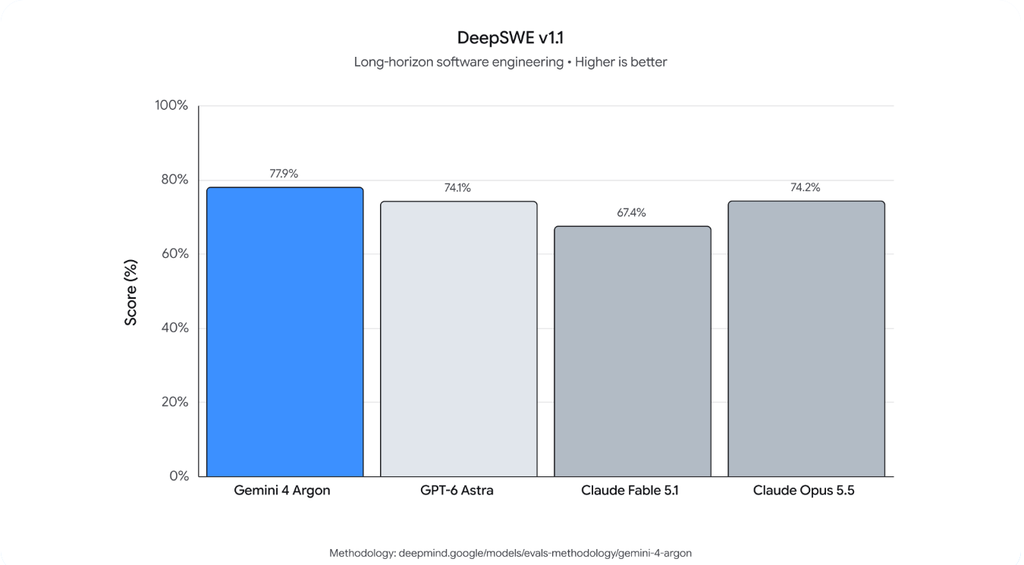
On DeepSWE v1.1 the model scored 77.9 percent. This benchmark measures performance on real world software engineering tasks that take many steps to complete. Google describes the result as a new state of the art.
For developers this is relevant because long tasks are where AI coding tools often fail. Fixing a single function is easy. Planning a change across many files and keeping it consistent is much harder. A strong score on a long horizon benchmark suggests progress on that harder problem. Still the real test will be how Argon performs on your own codebase once it becomes available.
Enterprise Knowledge Work
Google also highlights results outside coding. Argon is described as the leading model on the Vals Index. This index estimates economic impact across finance and coding as well as legal and tax work. Each sector is weighted by its share of U.S. GDP.
The model also performed strongly on more specific tests:
Vals Finance Agent v2 measures multistep financial research.
Harvey’s Legal Agent Benchmark measures legal research and drafting.
AutomationBench from Zapier measures end to end execution of core business tasks. Argon ranks first there with a score of 51.3 percent.
These tests point to a clear target audience. Google wants Argon to act as a capable assistant for analysts and lawyers and operations teams. The idea is that the model can take a goal and work through documents and tools until the job is done.
Strength in Visual Understanding
Many business tasks involve more than text. Contracts include tables and reports contain charts. Training material arrives as long videos. Google says Argon is particularly good when work depends on visual information.
According to the announcement the model can analyze professional charts and pick out details from long videos. It can also act on information spread across a series of documents. On LVBench which tests long video understanding Argon scored 91.7 percent and Google calls this state of the art.
Defensive Cybersecurity
Cybersecurity is a major focus of this launch and the reason the first access goes to trusted defenders. Google trained Argon to be highly capable at defense. The model can find and validate critical software vulnerabilities and then patch them without human help.
Google plans to release Argon without cyber guardrails to trusted defenders and its own internal security teams. The reasoning is that defenders need the full strength of the model to keep up with attackers. General users will get a version with safeguards in place.
Several results support the cyber claims:
Wiz is using Argon through its Scan for Good initiative. This program protects critical public infrastructure for free by finding and fixing high risk exposures. In an early test the model found a critical vulnerability in healthcare software used by hospitals around the world. The flaw exposed sensitive personal information and Google says earlier frontier models had missed it.
On CWE-bench v1 which tests how well a model fixes security vulnerabilities Argon tied for first place with a score of 68 percent.
On Google’s internal vulnerability benchmark Argon found a wide range of problems in complex codebases across 20 programming languages.
On Wiz’s internal black box penetration testing benchmark Argon did better than Gemini 3.8 Flash Cyber. The test checks whether a model can map the attack surface of a live web system without seeing the source code and then find weaknesses and produce proof of concept evidence.
Safety Work Before Wide Release
A model this capable in cybersecurity raises obvious safety questions. Google says it is strengthening safeguards in four areas before a broad launch.
Defending against misuse. Argon is designed to refuse harmful requests related to cyberattacks and chemical, biological, radiological and nuclear threats. At the same time it should still support legitimate scientific work that has dual uses. Google follows its Frontier Safety Framework here. The company is also improving how it monitors the internal activations of the model to detect misuse. Internal and external red teams tested these protections using both manual and automated attacks.
Defending against prompt injection. Indirect prompt injection happens when hidden instructions inside a document or web page try to hijack an AI agent. Google calls Argon its most resilient model against these attacks. Through automated red teaming and adversarial training it leads the Gray Swan Indirect Prompt Injection benchmark. This matters a great deal for agents that read emails and files on your behalf.
Monitoring for misalignment. Google is deploying systems that watch the chain of thought and the actions of the model. If Argon begins to go beyond what the user intended the system can stop execution. Google used a similar approach to monitor training runs and alert a dedicated incident response team. It took care not to feed those findings back into training because that could teach the model to hide its reasoning. The company also urges the wider industry to keep reasoning transparent during this period of fast capability growth.
Hardening systems. Testing powerful models requires secure environments. Google is isolating and sealing its sandboxes before any high risk training or evaluation begins. It says it will share these agent security practices with partners.
Why This Launch Matters
Several themes stand out in this announcement.
First the focus has shifted from chat to sustained work. Argon is pitched as a model that can carry out long projects with many steps. The jump in output length supports that direction.
Second Google is testing new ideas about release strategy. Giving a stronger version to vetted defenders first and holding back the public release is a cautious approach. It reflects the growing view that models with strong cyber skills need staged access.
Third the pricing is aggressive. Even at the later rate of $4 and $20 per million tokens Google is making a strong bid for developers and companies. The deep discount on cached input also rewards apps that reuse context.
What Developers and Businesses Should Do Now
You cannot use Argon yet unless you are part of the early access group but you can prepare.
Developers can review projects where long tasks are a bottleneck such as large refactors or test generation. These are the areas where a long horizon model may help most.
Companies can plan for budget differences between the introductory price and the standard price. They should also think about how cached input could lower costs for repeated workloads.
Security teams can look at the Fairwind Program to see whether they qualify for early access.
Everyone should keep security in mind. Agents that act on your behalf need strict permissions and careful monitoring no matter how strong the underlying model is.
Keep the Benchmarks in Perspective
The results in the announcement are impressive but they come from Google. Benchmarks are useful signals but they do not guarantee results in your own setting. A model that tops a coding test may still stumble on your specific stack. Independent reviews and hands on testing after public release will give a clearer picture.
It is also worth remembering that some of the biggest claims such as the memory savings and the Rust migrations are still moving toward production. Google itself says the migrations are going through audits and reviews. Treat them as promising early results rather than finished outcomes.
Frequently Asked Questions
What is Gemini 4 Argon?
It is Google’s new frontier AI model built for complex long running work in coding and enterprise knowledge tasks and cybersecurity defense.
When will it be available to everyone?
Google has not given a date. It says the model is rolling out soon and will reach developers and enterprises and consumers after more testing.
Who gets access first?
Trusted cyber defenders through the Fairwind Program have it now. Paid API customers and Google AI Ultra subscribers are expected to be first in the wider release.
How much will it cost?
The introductory price is $2 per million input tokens and $10 per million output tokens. After the introductory period it becomes $4 and $20. Cached input is 95 percent cheaper than standard input.
What is the output limit?
Argon can generate up to 1 million tokens in one response. The older limit was 64,000.
Final Thoughts
Gemini 4 Argon shows where the AI race is heading. The goal is no longer a chatbot that answers questions. It is a system that can take on a large goal and work through it for hours while staying safe. Google backs the launch with internal examples and strong benchmark scores and a phased release plan built around security.
The real verdict will arrive when the model reaches the public. Until then the announcement gives a useful preview of what the next generation of AI tools may offer. Keep an eye on official Google channels for the release date and for independent tests once Argon becomes widely available.
That comes to roughly 2000 words. I can also turn it into a file such as Markdown or Word if you want it ready to upload to your site.